Web page of Ryoko Oishi-Tomiyasu
Our research theme is to develop algorithms and applications for discrete structures such as lattices, rings of integers, and point configurations on Euclidean spaces and manifolds, by using tools and theories of geometry of numbers, algebraic number theory, discrete mathematics, convex optimization, and analytical methods related to quadratic forms and diffraction theory of crystals and quasicrystals.
Information
- 2025/8/8Talk & Org.
-
Workshop
Crossroads of Virology and Mathematical Sciences
@RIKEN iTHEMS.
Mathematical and crystallographic perspectives in virology
- 2025/7/30Talk & Org.
-
ACMB-JSMB2025@Kyoto, 2025/6/9--13.
[MS12] Mini-symposium Mathematical and Computational Perspectives of Phyllotaxis and Growth of Plants 10:10--2:50
Pattern formation on general surfaces and 3D volumes via a generalization of the golden angle method
- 2025/6/12Talk
-
CATQFL 2025(Conference on the Arithmetic Theory of
Quadratic Forms and Lattices)@Seoul National University, 2025/6/9--13.
Piecewise-linear embeddings of the space of rank-3 lattices into R13 for high-throughput handling of lattice parameters
, arxiv
- 2025/2/28Talk
- Applications of Geometry of Numbers to Phyllotaxis and Crystallography@iTHEMS seminar, RIKEN.
- 2024/12/20Talk
-
Part I: Generalized golden angle method derived from ideas of mathematical botany, geometry of numbers and differential geometry
Part II: Methods for working as a mathematician at the boundary or outside the mathematical community@Catch-all Mathematical Colloquium of Japan (online)
- 2024/10/21--23Talk
- Application of geometry of numbers and the theory of PDEs to the generalized golden angle method (point packing generation derived from mathematical botany)@Tilings, quasiperiodicity and related topics(Kyoto University)
- 2024/9/30Paper
-
A paper on generalized golden angle method has been published from Constructive Approximation: " Packing Theory Derived from Phyllotaxis and Products of Linear Forms".
- 2024/9/14--16Talk
- Wavelet OS " Statistical extension of sampling theorems for a finite number of sampled values " @JSIAM Annual Meeting 2024(Kyoto University)
- 2024/7/1Paper
-
A paper on mathematical methods for crystal lattices has been published in Acta Cryst A.
" Ideas of lattice-basis reduction theory for error-stable Bravais lattice determination and ab initio indexing", which explains fast methods for Bravais-lattice determination and lattice identification under observational errors."
- 2024/3/13Talk
- AIMR Math Group Seminar@AIMR, Tohoku University.
Applications of lattice-basis reduction theory to crystal structure analysis
(This talk is prepared for experimental scientists.)
- 2024/2/29Paper
- The expository article on CONOGRAPH software was published from the Journal of the Crystallographic Society of Japan:
An Ab-Initio Indexing Method Using Conway's Topograph and Mathematical Ideas Behind It.
I noticed that I had never written in Japanese about this application of Conway's topograph.
- 2024/2/11--15Talk
- ANZIAM 2024@Adelaide Hills Convention Centre.
Packing theory derived from phyllotaxis and products of linear forms
- 2024/2/1Others
- All my open-source codes on OSDN (sourceforge.jp 10 years ago) have been moved to GitHub due to OSDN's constant connection troubles.
PROFILE
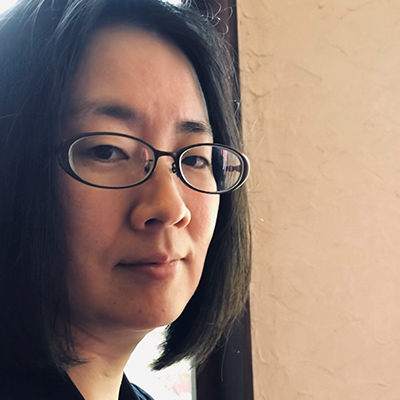
Institute of Mathematics for Industry, Kyushu UniversityProfessor Ryoko Tomiyasu
- History
- 2008 Research fellow IMSS, KEK → 2010 Ph.D of Mathematical Sciences (Supervised by Prof. Takayuki Oda of The University of Tokyo) → 2011 Assistant Professor IMSS, KEK → 2015 JST PRESTO Researcher (Nishiura lab of AIMR, Tohoku University) → 2016 Associated Professor, Yamagata University → 2019 Associated Professor, Kyushu University.
- Expertise
- Applied algebra, Number theory, Mathematical crystallography
I'm interested in algebra, discrete mathematics and number theory, and using them to solve various problems in nature.
My projects are supported by the following grants:
Grant-in-Aid for Scientific Research (C):“Study on discrete point sets to produce new applications of lattice theory and algebraic computation.”
JST FOREST:“Discrete modeling with a new biological-origin method for packing and mesh generation.”
- Multidisciplinary research
- I have been collaborating with the scientific community for many years, in order to find new mathematical problems. Software development works as a useful communication tool for this. I've also published papers based on mathematics including number theory(e.g., ambiguities in lattice determination), in response to the scientific community's need.
Web pages about my research outside the university
Distributed Software
Open Source (The methods are described in the articles)
The following are cited in International Tables Vol. H (volume of powder diffraction)
- Powder autoindexing software Conograph CUI version (C++, OpenMP)
- Error-stable Bravais lattice determination program in CONOGRAPH (C++)
- Peak search program in CONOGRAPH (C++)
Software for J-PARC users
- Powder autoindexing software Conograph
- Rietveld analysis software (open source; Z-Rietveld code belongs to KEK as intellectual property. Please contact us if you want to use it.)